How AMEX gets 685.3% APR and what it actually means
I can finally do the same calculation on a piece of paper, and you can read about it here

I am so incredibly annoyed. I should be overjoyed for finding The One True Solution™ that all banks in the UK use to come up with their APR figures, but alas. Turns out that the mantra of It Depends™ still works, even when we have legislation attached to it.
For context, everything began when I saw an ad for an AMEX card in one of the tube stations in London in May of 2024 that had more than 700% APR.

I am writing this on 17th October 2026. The current details of the platinum card is 685.3%, £650 yearly fee, 29.1% purchase rate: https://www.americanexpress.com/en-gb/credit-cards/platinum-card.
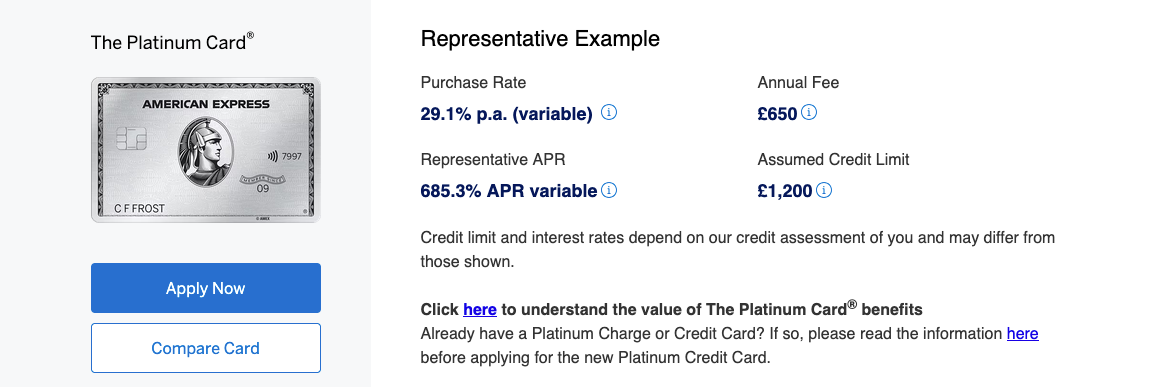
I went looking, turns out that every credit card APR uses the same basis:
- £1,200 borrowed
- start paying back immediately
- 12 equal installments
- all obligatory fees included (like yearly fees)
- no other fees included (like late fees because you are late)
Surely, I thought, borrowing £1,200 would not cost me £8,455.2 (704.6% of £1,200) to pay back...
EVERY.
SINGLE.
STEP.
In perfect $L^{A}T_{E}X$. You’re welcome. Or I’m sorry. Pick one. 😉
The search and initial failures
Not long after I started noodling on this, I found the CONC App 1.2 guidance from the FCA.
CONC - Consumer Credit Sourcebook.
That guidance details the assumption, calculation method, everything. Even adds this fantastic equation on how the APR gets calculated:
$$\sum_{k=1}^{m}C_k(1 + X)^{-t_k} = \sum_{l-1}^{m'}D_l(1+X)^{-S_l}$$
Or, in a slightly “simpler” form:
$$S = \sum_{k=1}^{n}A_k(1 + X)^{-t_k}$$
Where:
- $S$ – present value of cash flows, we want this to be 0
- $n$ – top of the sum: number of months, this is 12
- $k$ – the current step of the period, this would be 1, 2, 3, ...12
- $A_k$ – current flow at period $k$
- $X$ – APR, this is what we want to find out
- $t_k$ – the time fraction of the period. For month 1, that would be $1\div12$, for month 7, it would be $7\div12$
What does that even mean?
That right there is what’s called an IRR – Internal Rate of Return – calculation. IRR, PV – present value –, and FV – future value – calculations are the same, the difference is what’s missing from them.
- PV: I know the amount in the future. What's the value now, so that it becomes that value in the future? Or how much is a future payment worth today? For example: “how much money do I need to start with today, so my account reaches £100,000 in 5 years with 4% interest?” Assuming compound interest, you need to deposit £82,192.71 today, so at 4% it will reach £100,000 in 5 years. The 82k is the present value of the 100k in 5 years.
- FV: I know the amount right now. What's going to be the value in the future? For example if I start with £100,000 today, how much will I have in 5 years at 4% interest? The answer is £121,665.29. The future value of £100,000 today is that much.
- IRR: what is the actual cost of the deal, fees included, during its lifetime? As an example: I buy a machine for £100,000 on credit at 5.9% interest. It's a hire purchase, so after 5 years I will have paid for the machine, all interest, fees, and I will own it. There's a £1,200 setup fee payable at start, a £12,000 deposit taken at start, and a yearly compliance fee of £800 I have to pay to the bank when they inspect it every year at month 11 to make sure I keep it maintained per the contract. The effective annual rate of that is 8.35%. I’ll break down how I got to this number. The question this percentage answers: if I have the £100,000 cash on me, what interest would a savings account need to pay so it’s worth taking out the credit and putting the cash into the savings account?
I thought this is about credit cards
Right, yes. So the whole point of that standardisation is that you get to compare apples to apples. A lot of the numbers will change in real life with credit agreements based on length of credit, repayment schedules, amount of credit, which will very easily fool most people, so having something fixed that everyone should adhere to should help.
The APR calculation per the regulation fixes most variables except 2 (and a half):
- the purchase rate of a credit card, ie how much interest you’re going to pay on balance you’ve not paid back (don’t ever not pay a credit card in full!)
- the yearly fee of a credit card
- (this is the half): the timing of the fee: some cards do monthly fees, this will impact things
First method of calculations
The wrong one. I got stuck on this for a year and a half.
Given that we know the equation, and we know most of the variables, calculating the APR shouldn’t be hard. At £1,200 credit at 29.1% interest, the way to get 12 equal repayments is by using the standard annuity formula:
$$PMT = P \cdot \frac{r_m}{1 - (1 + r_m)^{-n}}$$
Where:
- $PMT$ – monthly fixed payment such that $n$ of them will exactly clear the total cost. This is what we’re after for the “12 equal payments” figure.
- $P$ – principal. This is the amount of money you borrowed that interest is charged on. In our case, this is £1,200.
- $r_m$ – monthly rate of interest. There’s another formula for that, but it’s 0.021513, or 2.1513%
- $n$ – number of intervals. It’s months in a year, so 12.
Let’s find the $r_m$ first using this formula:
$$(1 + r_m)^{12} = 1 + r$$
Where:
- $r_m$ is the effective monthly rate, this is what we’re after
- $r$ is the annual percentage in decimals. 29.1% is 0.291
Substitute the 0.291 in, rearrange to get
$$r_m = (1.291)^{1/12} - 1$$
Then ✨ math ✨ happens, because we have this identity (see Powers via logarithms at WikiPedia and Whitman College Calculus):
$$ \begin{aligned} a &= \mathrm{e}^{\ln a} \\ a^b &= {(\mathrm{e}^{\ln a})}^b \\ a^b &= \mathrm{e}^{\,b \cdot \ln a} \\ \end{aligned} $$Applying that to the monthly effective rate, we can rewrite that as
$$ \begin{aligned} r_m &= (1.291)^{1/12} - 1 \\ r_m &= \mathrm{e} ^ {\frac{1}{12} \cdot \ln (1.291)} - 1 \\ r_m &= \mathrm{e} ^ {\frac{1}{12} \cdot 0.2554171119} -1 && \text{since } \ln (1.291) \approx 0.2554171119 \\ r_m &= \mathrm{e} ^ {0.0212847593} -1 && \text{since } \frac{1}{12} \cdot 0.2554171119 \approx 0.0212847593 \\ r_m &= 1.0215129 - 1 && \text{since } \mathrm{e} ^ {0.0212847593} \approx 1.0215129 \\ r_m &= 0.0215129 \end{aligned} $$Which gives us 2.1513% $r_m$, or monthly effective rate.
And now we can go back to calculating the montly payments!
$$ \begin{aligned} PMT &= P \cdot \frac{r_m}{1 - (1 + r_m)^{-n}} \\ \\ PMT &= 1200 \cdot \frac{0.0215129}{1 - (1 + 0.0215129)^{-12}} \\ \\ PMT &= 1200 \cdot \frac{0.0215129}{1 - (1.0215129)^{-12}} \\ \\ PMT &= 1200 \cdot \frac{0.0215129}{1 - (1.0215129)^{-12}} \\ \\ PMT &= 1200 \cdot \frac{0.0215129}{1 - 0.774593298} \\ \\ PMT &= 1200 \cdot \frac{0.0215129}{0.225406702} \\ \\ PMT &= 1200 \cdot 0.0954403743 \\ \\ PMT &= 114.52844916 \end{aligned} $$That £114.53 is getting plugged into the “simpler” form from above. Here it is again:
$$S = \sum_{k=1}^{n}A_k(1 + X)^{-t_k}$$
To do that, we have to know the flows at each step. For the AMEX card with the £650 yearly fee, these are:
- $t_0$: +1200 – getting the credit, and -650 – paying the yearly fee, which can be collapsed into a +550
- $t_1$: -114.53
- $t_2$: -114.53
- $t_3$: -114.53
- $t_4$: -114.53
- $t_5$: -114.53
- $t_6$: -114.53
- $t_7$: -114.53
- $t_8$: -114.53
- $t_9$: -114.53
- $t_{10}$: -114.53
- $t_{11}$: -114.53
- $t_{12}$: -114.53
You then need to sum up the result of this equation for each step:
$$ \begin{aligned} 550 \cdot (1 + X)^{0/12} &= 550 && \text{since } a^0 = 1 \\ -114.53 \cdot (1 + X)^{1/12} &= x_0 \\ -114.53 \cdot (1 + X)^{2/12} &= x_1 \\ \cdots \\ -114.53 \cdot (1 + X)^{12/12} &= x_{12} \end{aligned} $$We want the sum to be 0, so
$$550 + x_0 + x_1 + \cdots + x_{12} = 0$$
That sum is driven by $X$. It’s not something we can calculate straight, so we have to brute force it. There are two ways of doing it:
- bisection (pick lower, higher, check middle, see where that lands, refine)
- Newton-Raphson method (it involves derivation, fewer steps, but more involved, so read the wiki article about it instead, I’m not going to use it here)
Let’s pick 0 and 100 as lower and upper bounds for the bisect method. Here are the steps:
- $S_0$: bounds: [0,100], midway 50, sum is 260.3881066, above 0, so it’s in the lower half (0-50)
- $S_1$: bounds: [0, 50], midway 25, sum is 196.9689796, lower half
- $S_2$: bounds: [0, 25], midway 12.5, sum is 112.1693035
- $S_3$: bounds: [0, 12.5], midway 6.25, sum is -0.069118307, upper half
- $S_4$: bounds: [6.25, 12.5], midway 9.375, sum is 69.20602848 (nice), lower half
- $S_5$: bounds: [6.25, 9.375], midway is 7.8125, sum is 39.34889219
- $S_6$: bounds: [6.25, 7.8125], midway is 7.03125, sum is 21.13462983
- $S_7$: bounds: [6.25, 7.03125], midway is 6.640625, sum is 10.95594396
- $S_8$: bounds: [6.25, 6.640625], midway is 6.4453125, sum is 5.556424091
- $S_9$: bounds: [6.25, 6.4453125], midway is 6.34765625, sum is 2.772883481
- $S_{10}$: bounds: [6.25, 6.34765625], midway is 6.298828125, sum is 1.359317648
- $S_{11}$: bounds: [6.25, 6.298828125], midway is 6.274414063, sum is 0.646974702
- $S_{12}$: bounds: [6.25, 6.274414063], midway is 6.262207031, sum is 0.28939901
- $S_{13}$: bounds: [6.25, 6.262207031], midway is 6.256103516, sum is 0.110258313
- $S_{14}$: bounds: [6.25, 6.256103516], midway is 6.253051758, sum is 0.020599525
- $S_{15}$: bounds: [6.25, 6.253051758], midway is 6.251525879, sum is -0.024252006, upper half
- $S_{16}$: bounds: [6.251525879, 6.253051758], midway is 6.252288818, sum is -0.001824395
- $S_{17}$: bounds: [6.252288818, 6.253051758], midway is 6.252670288, sum is 0.009388027, lower half
- $S_{18}$: bounds: [6.252288818, 6.252670288], midway is 6.252479553, sum is 0.003781931, and this is sufficiently close to 0 for our illustration
Using this calculation, we get 6.252479553, which corresponds to roughly 625.25%.
That is very much not the stated 685.3%.
This is where I lost a year and a half, trying to figure out what went wrong, how I did the calculation, what does the $\sum$ symbol even mean? I searched on reddit, internet, nothing helped, until someone suggested a different method below.
The correct solution
at least for that AMEX card
Turns out when CONC App 1.2 says “equal monthly repayments,” they could mean the capital. When you borrow £1200, and you repay the capital in equal monthly installments, you’ll pay £100 a month.
I see you being confused over there, because obviously there’s the question of interest. And you’re correct, and in this case the interest changes month to month as your capital gets lower, and thus there’s less capital to charge interest on. The calculations become more complex though, as each month we need to recalculate the interest.
Here’s a handy table breaking down what happens at each month.
| $t$ | $B_t$ | Capital | Interest $I_t$ | $PMT_t$ | Flow |
|---|---|---|---|---|---|
| 0 | — | — | — | — | +550.0000 |
| 1 | 1200.00 | 100.00 | 25.8155 | 125.8155 | −125.8155 |
| 2 | 1100.00 | 100.00 | 23.6642 | 123.6642 | −123.6642 |
| 3 | 1000.00 | 100.00 | 21.5129 | 121.5129 | −121.5129 |
| 4 | 900.00 | 100.00 | 19.3616 | 119.3616 | −119.3616 |
| 5 | 800.00 | 100.00 | 17.2103 | 117.2103 | −117.2103 |
| 6 | 700.00 | 100.00 | 15.0590 | 115.0590 | −115.0590 |
| 7 | 600.00 | 100.00 | 12.9077 | 112.9077 | −112.9077 |
| 8 | 500.00 | 100.00 | 10.7564 | 110.7564 | −110.7564 |
| 9 | 400.00 | 100.00 | 8.6052 | 108.6052 | −108.6052 |
| 10 | 300.00 | 100.00 | 6.4539 | 106.4539 | −106.4539 |
| 11 | 200.00 | 100.00 | 4.3026 | 104.3026 | −104.3026 |
| 12 | 100.00 | 100.00 | 2.1513 | 102.1513 | −102.1513 |
- $B_t$ – balance remaining at each step
- Capital – how much capital is repaid in that month
- $I_t$ – how much interest is charged in that month. That comes from $I_t = B_t \cdot r_m$. At month 1 it’s $I_t = 1200 \cdot 0.0215129$, which comes to $\approx 25.8155$.
- $PMT_t$ is the payment in that month. It’s capital + interest.
- Flow is the cash flow for the purposes of the calculations.
Using the same formula as above to get to the sum and find the correct percentage, we can plug the flows into each step. The formula for reference again:
$$S = \sum_{k=1}^{n}A_k(1 + X)^{-t_k}$$
Same bisection method as above:
- $S_0$: bounds: [0,100], midway 50, sum is 244.5760824, above 0, so it’s in the lower half (0-50)
- $S_1$: bounds: [0, 50], midway 25, sum is 180.2571241
- $S_2$: bounds: [0, 25], midway 12.5, sum is 95.08599136
- $S_3$: bounds: [0, 12.5], midway 6.25, sum is -16.54520141, upper half
- $S_4$: bounds: [6.25, 12.5], midway 9.375, sum is 52.22624155, lower half
- $S_5$: bounds: [6.25, 9.375], midway is 7.8125, sum is 22.53876626
- $S_6$: bounds: [6.25, 7.8125], midway is 7.03125, sum is 4.463986261
- $S_7$: bounds: [6.25, 7.03125], midway is 6.640625, sum is -5.625512159, upper half. This is the first deviation between this, and the annuity calculation above
- $S_8$: bounds: [6.640625, 7.03125], midway is 6.8359375, sum is -0.483705159
- $S_9$: bounds: [6.8359375, 7.03125], midway is 6.93359375, sum is 2.013631028, lower half
- $S_{10}$: bounds: [6.8359375, 6.93359375], midway is 6.884765625, sum is 0.770929593
- $S_{11}$: bounds: [6.8359375, 6.884765625], midway is 6.860351563, sum is 0.145115867
- $S_{12}$: bounds: [6.8359375, 6.860351563], midway is 6.848144531, sum is -0.16891722, upper half
- $S_{13}$: bounds: [6.848144531, 6.860351563], midway is 6.854248047, sum is -0.01180651
- $S_{14}$: bounds: [6.854248047, 6.860351563], midway is 6.857299805, sum is 0.066678196, lower half
- $S_{15}$: bounds: [6.854248047, 6.857299805], midway is 6.855773926, sum is 0.027441726
- $S_{16}$: bounds: [6.854248047, 6.855773926], midway is 6.855010986, sum is -0.001824395, upper half
- $S_{17}$: bounds: [6.855010986, 6.855773926], midway is 6.855392456, sum is 0.01763077, lower half
- $S_{18}$: bounds: [6.855010986, 6.855392456], midway is 6.855201721, sum is 0.012725016
- $S_{19}$: bounds: [6.855010986, 6.855201721], midway is 6.855106354, sum is 0.010272071
- $S_{20}$: bounds: [6.855010986, 6.855106354], midway is 6.85505867, sum is 0.00904558
- $S_{21}$: bounds: [6.855010986, 6.85505867], midway is 6.855034828, sum is 0.008432331
- $S_{22}$: bounds: [6.855010986, 6.855034828], midway is 6.855022907, sum is 0.008125705, which is sufficiently close to 0 for our calculationse
And that’s 6.855022907, or 685.5%. It’s 0.2% off from the official figures, but that’s most likely due to a rounding error that gets accumulated. For example the purchase rate could be 29.05%, or 29.149% internally, the APR could be 685.25%, or 685.349%, and how many digits we calculate the individual interests per month also matters. That deviation is Close Enough™ that it’s acceptable.
And we’re done!
There are a few other questions, like “what if the card has a monthly fee?” or “what if the yearly fee is paid at the end of the cycle?” or “okay, but what is HSBC even doing, I can’t calculate their stated 100.2% APR using any of these?!”
Valid questions, so let’s look at the monthly first.
Card fee, but monthly
You’d think a monthly card fee is dumb, but Lloyds does it with their, uh ... <puts spectacles on>... World Elite Mastercard®.
Same table as above, but with two more columns: fee at the end, and monthly fee:
| $t$ | $B_t$ | Capital | Interest $I_t$ | $PMT_t$ | Fee at start | Fee at end | Monthly fee |
|---|---|---|---|---|---|---|---|
| 0 | — | — | — | — | +550.0000 | +1200.0000 | +1200.0000 |
| 1 | 1200.00 | 100.00 | 25.8155 | 125.8155 | −125.8155 | −125.8155 | −179.9822 |
| 2 | 1100.00 | 100.00 | 23.6642 | 123.6642 | −123.6642 | −123.6642 | −177.8309 |
| 3 | 1000.00 | 100.00 | 21.5129 | 121.5129 | −121.5129 | −121.5129 | −175.6796 |
| 4 | 900.00 | 100.00 | 19.3616 | 119.3616 | −119.3616 | −119.3616 | −173.5283 |
| 5 | 800.00 | 100.00 | 17.2103 | 117.2103 | −117.2103 | −117.2103 | −171.3770 |
| 6 | 700.00 | 100.00 | 15.0590 | 115.0590 | −115.0590 | −115.0590 | −169.2257 |
| 7 | 600.00 | 100.00 | 12.9077 | 112.9077 | −112.9077 | −112.9077 | −167.0744 |
| 8 | 500.00 | 100.00 | 10.7564 | 110.7564 | −110.7564 | −110.7564 | −164.9231 |
| 9 | 400.00 | 100.00 | 8.6052 | 108.6052 | −108.6052 | −108.6052 | −162.7719 |
| 10 | 300.00 | 100.00 | 6.4539 | 106.4539 | −106.4539 | −106.4539 | −160.6206 |
| 11 | 200.00 | 100.00 | 4.3026 | 104.3026 | −104.3026 | −104.3026 | −158.4693 |
| 12 | 100.00 | 100.00 | 2.1513 | 102.1513 | −102.1513 | −752.1513 | −156.3180 |
Notes:
- the total yearly fee is still £650 so we can compare how the APR changes based on when that fee is paid
- with fee at start, like the AMEX one, the fee gets taken out immediately, which results in the +550 (+1200 - 650) at $t_0$
- with fee at end and monthly fee, $t_0$ is +1200, as that’s how much money you have available
- fee monthly is $\text{£}650 \div 12$, giving us 54.1666666667, which will cause rounding errors. The table uses 4 decimals. Every month the flow is $PMT_t + 54.1667$.
- fee at end months 1-11 are the same $PMT_t$ as fee at start, except month 12, which is $PMT_t + 650$ going out, which totals to $-(102.1513 + 650) = -752.1513$.
Card fee, but capitalised
HSBC’s World Elite MasterCard has a £290 annual fee, and a 29.9% purchase rate per annum, with a stated APR of 100.2%. None of the existing ways to calculate that will get to 100.2%, unless you use annuity calculations, and you add the yearly fee to the capital that you need to repay, so your starting cash flow is £1490 rather than £1200, or £910 (1200-290), and even then it’s approximate, because the 29.9% is not the basis of the calculation, their monthly 2.209% is (which comes to 29.98% per annum, so it’s not even rounding).
The table below is still using AMEX’s details: straight-line calculation, £650 fee, 29.1% purchase rate. The HSBC one will have its own table later.
| $t$ | $B'_t$ | Capital | Interest $I'_t$ | $PMT'_t$ |
|---|---|---|---|---|
| 1 | 1850.0000 | 154.1667 | 39.7989 | 193.9655 |
| 2 | 1695.8333 | 154.1667 | 36.4823 | 190.6490 |
| 3 | 1541.6667 | 154.1667 | 33.1657 | 187.3324 |
| 4 | 1387.5000 | 154.1667 | 29.8491 | 184.0158 |
| 5 | 1233.3333 | 154.1667 | 26.5326 | 180.6992 |
| 6 | 1079.1667 | 154.1667 | 23.2160 | 177.3827 |
| 7 | 925.0000 | 154.1667 | 19.8994 | 174.0661 |
| 8 | 770.8333 | 154.1667 | 16.5829 | 170.7495 |
| 9 | 616.6667 | 154.1667 | 13.2663 | 167.4330 |
| 10 | 462.5000 | 154.1667 | 9.9497 | 164.1164 |
| 11 | 308.3333 | 154.1667 | 6.6331 | 160.7998 |
| 12 | 154.1667 | 154.1667 | 3.3166 | 157.4832 |
| Total | — | 1850.00 | 258.69 | 2108.69 |
Totals are therefore
| Fee at start | Fee at end | Monthly fee | Fee added to balance | |
|---|---|---|---|---|
| Received ($CF_0$) | +550.00 | +1200.00 | +1200.00 | +1200.00 |
| Paid ($\sum_{t=1}^{12}$) | −1367.80 | −2017.80 | −2017.80 | −2108.69 |
| Net (undiscounted) | −817.80 | −817.80 | −817.80 | −908.69 |
| Interest included | 167.80 | 167.80 | 167.80 | 258.69 |
| Fee included | 650.00 | 650.00 | 650.00 | 650.00 |
| Monthly IRR | 18.739% | 7.096% | 9.332% | 10.396% |
| APR (IRR) | ≈ 685.5% | ≈ 127.6% | ≈ 191.7% | ≈ 227.7% |
In all cases the amount of interest and fees are the same, except for the fee added to the balance one where you pay interest on the fee too. You paid 167.80 in interest, and 650 in fees, which comes to 817.80. Adding the fee to the balance adds +£90.89 in interest. Sneaky. The APR also changes significantly purely as a function of when the yearly fee was paid.
And now we’re truly done.
The HSBC card
Yearly fee of £290 capitalised, 2.209% monthly rate, taken from the details pdf from the bank, which comes to 29.98% yearly effective rate, and annuity calculation:
| $t$ | $B_t$ | Capital | Interest $I_t$ | $PMT$ |
|---|---|---|---|---|
| 1 | 1490.0000 | 109.7944 | 32.9141 | 142.7085 |
| 2 | 1380.2056 | 112.2197 | 30.4887 | 142.7085 |
| 3 | 1267.9859 | 114.6987 | 28.0098 | 142.7085 |
| 4 | 1153.2872 | 117.2324 | 25.4761 | 142.7085 |
| 5 | 1036.0548 | 119.8220 | 22.8865 | 142.7085 |
| 6 | 916.2328 | 122.4689 | 20.2396 | 142.7085 |
| 7 | 793.7639 | 125.1742 | 17.5342 | 142.7085 |
| 8 | 668.5897 | 127.9393 | 14.7691 | 142.7085 |
| 9 | 540.6504 | 130.7655 | 11.9430 | 142.7085 |
| 10 | 409.8848 | 133.6541 | 9.0544 | 142.7085 |
| 11 | 276.2307 | 136.6065 | 6.1019 | 142.7085 |
| 12 | 139.6242 | 139.6242 | 3.0843 | 142.7085 |
| Total | — | 1490.00 | 222.50 | 1712.50 |
That comes to an APR of roughly 99.99%.
CONC App 1.2 is still messy
I still can’t compare apples to apples
There are so many variations that don’t really help the comparability of the cards. I started this entire blog post more than 2 years ago when I saw that 704.6% APR on the London Tube. I accidentally went down the rabbit hole (hyperfocus and autism), but here’s why I still can’t compare cards based on the APR alone precisely:
- APR will vastly change depending on how banks charge the fee over the year. AMEX’s £650 up front subtracted from the cash flow (because you pay it back immediately) gives you the 685.3% APR. If AMEX charged that same £650, except in equal monthly chunks, the APR would be 191.7%. Still a large number, but significantly better than the 685.3%. As a consumer, I pay the exact same for fees and interest in both scenarios.
- Banks get to choose how to interpret the “paid back in 12 equal monthly installments” line in the guidance. AMEX uses a capital only straight line method and they calculate the interests each month, so each month’s repayments are different from my, the consumer’s, point of view. HSBC uses the annuity formula, and the amount of money being paid to the bank is the same each month, but the split of capital / interest changes from month to month, always adding up to the same total. I have no idea which one Lloyd’s uses.
- Banks also get to choose what the basis of the calculations are when it comes to purchase rate: some are driven by the annual percentage, so you calculate the monthly rate. Others — and looking at you, HSBC! — calculate interest based on the monthly rate, and come to an annualised effective rate. Their stated monthly rate is 2.209%, which comes to 29.98% annual, which can only be truncated to 29.9%, not rounded.
- Banks also get to choose whether the calculation is based on monthly intervals where the assumption is that each month is uniform in time, which gives us fractions like $\frac{1}{12} \frac{2}{12} \frac{3}{12} \ldots$, or daily, which gives you fractions like $\frac{1}{365} \frac{120}{365}\text{ or }\frac{121}{366}\text{ for leap years}$. As the daily fractions depend on what day you start your year in the calculation, technically the same yearly fee and purchase rate can still give you slightly different APRs across the year based on start date, and whether we’re in a leap year or not. Granted, this is not going to be significant, but can drive you nuts trying to figure out why you’re not getting the same result.
Very importantly, as I stated in the begginning, I am not a lawyer, an economist, or a finance guy. There might very well be nuances that I completely missed, or things I got wrong. The results I have are good enough for me. It no longer bothers me seeing a huge APR percentage, because I know what that means.
All of this information is for educational purposes only.
I leave two things in the additional resources: a chart that runs locally only, and an excel file you can download and mess around with. There are only formulae in there, no macros.
Additional reasources
Excel sheet and a graph!
Calculator
The calculator has monthly and daily calculation modes. In daily calculation mode you also get to play around with the start date. It gives you numbers both for leap and non leap years.
Use the sliders to change the purchase rate and the yearly fee values. Max purchase rate is 45%, and max yearly fee is set to £700. If you need values outside of these, the Excel file is the way to go.
The Excel file
Here’s the excel file. It has monthly and daily calculations, all 4 scenarios (fee at start, fee at end, fee monthly, and fee capitalised), both in annuity and straight-line repayment modes. It does not have links, macros, embeddings. It has a single form control in the daily sheet.
In conclusion
Hopefully you found all of this informative and helpful. Maybe even interesting.
Thanks for reading!
Hero photo by Bozhin Karaivanov on Unsplash